
A pergola does something no other garden feature can. It gives you a room outdoors, with a ceiling of timber, climbers or louvres, while still feeling open. That is why pergolas in Cheltenham gardens have gone from a rare extra to one of the first things people ask us for.
However, a pergola is also a structure, and structures come with rules. Height, position and the type of house you live in all matter. So this guide covers what you can build, where, and which style will suit your garden.
The short answer: Most pergolas in Cheltenham do not need planning permission, as long as they stay within the permitted development limits for garden structures. The key number is 2.5 metres: that is the maximum height for anything within 2 metres of a boundary. Listed buildings and conservation areas have extra rules.
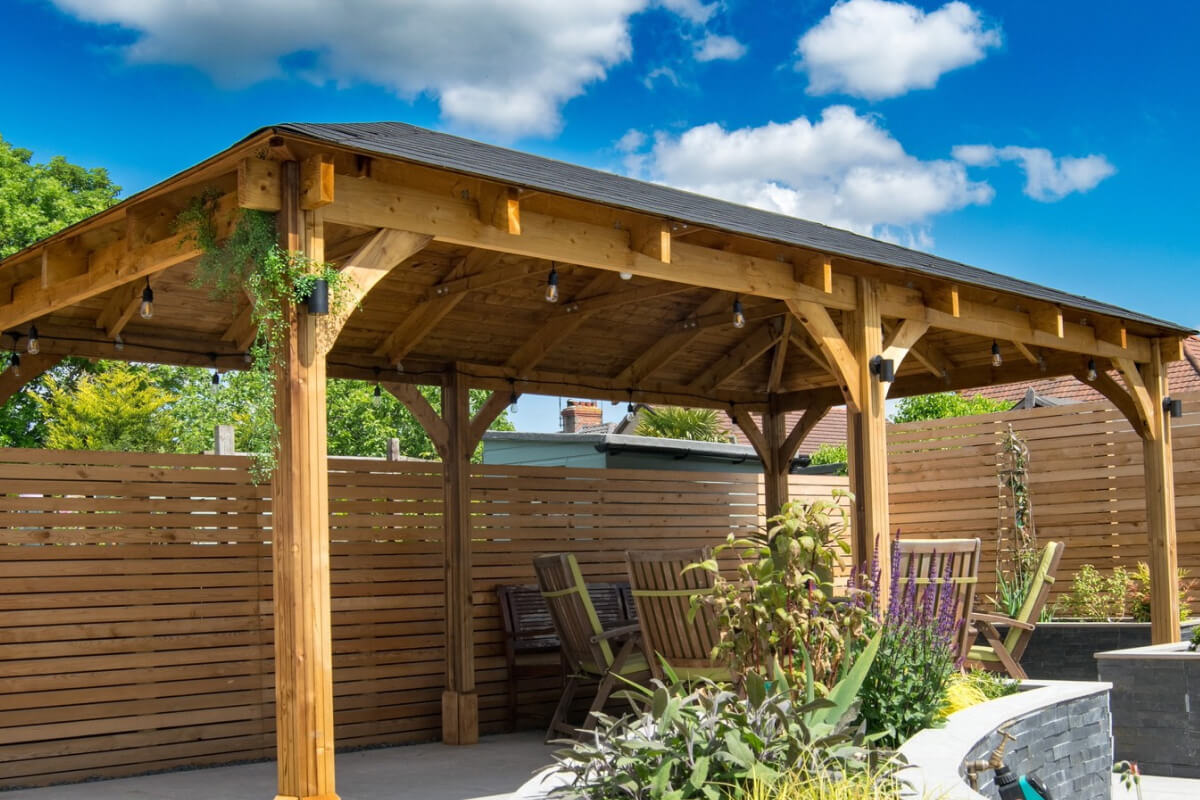
Do pergolas in Cheltenham need planning permission?
Usually not. A pergola is treated like other garden structures, such as sheds and summerhouses. It counts as permitted development if it meets the standard limits.
- Within 2 metres of a boundary, the whole structure must be no higher than 2.5 metres.
- Further from the boundary, it can be up to 3 metres high, or 4 metres with a dual-pitched roof.
- It must not sit forward of the front wall of the house.
- Garden structures must not cover more than half of the land around the original house.
- Raised platforms over 30 centimetres high are not allowed without permission.
You can read the full rules on the Planning Portal page for outbuildings. Pergolas are not named in the legislation, so if your plan is close to a limit, ask the council to confirm.
The Cheltenham factor: conservation areas and listed homes
This is where Cheltenham differs from most towns. Its Central Conservation Area covers a very large part of the town, and the town has a great many listed Regency buildings.
Listed buildings. Garden structures within the grounds of a listed building are not permitted development. Therefore, you will need to apply.
Conservation areas. A structure to the side of the house needs permission on this type of protected land. Rear gardens are usually fine, but check first.
The Cotswolds National Landscape. Homes on the edge of town towards Leckhampton Hill and Cleeve Hill may fall inside it. Here, any structure more than 20 metres from the house is limited to 10 square metres.
Because of this, we always check the planning status of a property before we draw a pergola into a design.
Timber, oak or aluminium: which suits pergolas in Cheltenham?
| Softwood timber | Green oak | Aluminium louvred | |
|---|---|---|---|
| Look | Warm, simple, easy to stain | Rich, traditional, weathers to silver | Sleek, modern, crisp lines |
| Roof | Open rafters or slats | Open, or tiled and solid | Adjustable louvres, rainproof when closed |
| Upkeep | Treat every few years | Very little, will crack and move naturally | Wipe down |
| Best for | Climbers and cottage style | Period homes and dining areas | Contemporary gardens and year-round use |
| Lifespan | Good if treated and kept off wet ground | Very long | Very long |
In general, softwood costs least and oak and aluminium cost more. However, size, roof type, electrics and the base change the price a great deal, so we quote each one after a visit.
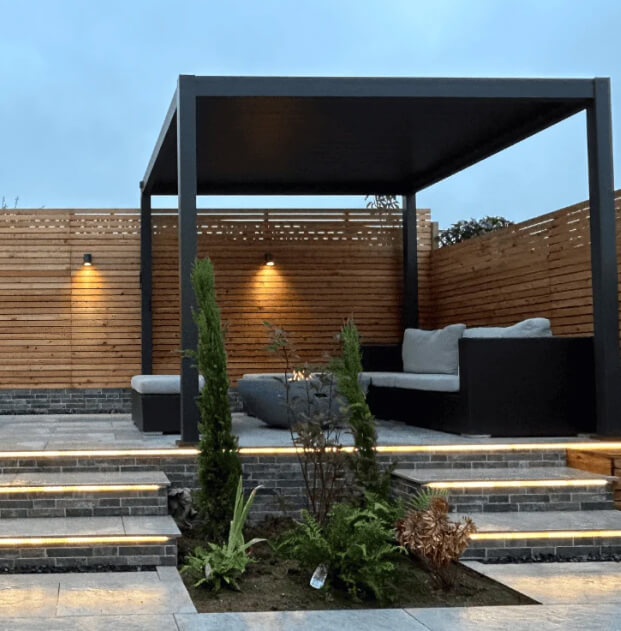
6 pergola ideas that work
1. Over the dining table. The classic use for pergolas in Cheltenham. A pergola frames the table and gives you somewhere to hang lights. As a result, the terrace feels like a room.
2. Against the house. A lean-to pergola over the back doors shades the kitchen in summer. In addition, it links the house and garden.
3. At the far end. A pergola at the bottom of the garden gives you a reason to walk there. It also catches the evening sun that the house terrace may miss.
4. As a privacy screen. Slatted sides and a planted roof block the view from upstairs windows next door. This works far better than a taller fence.
5. Over a hot tub or outdoor kitchen. A solid or louvred roof keeps the rain off, so you use the space all year. See our outdoor kitchens page for examples.
6. As a walkway. A run of arches over a path, planted with roses or wisteria, turns a plain route into a feature.
The myth: a pergola always needs a roof
Many people assume open pergolas in Cheltenham are pointless in our weather. In practice, open rafters do more than you might think. They cast dappled shade, hold climbers and lights, and make a space feel sheltered.
That said, if you want to sit out in the rain, choose louvres or a solid roof. Just remember that a solid roof adds height and weight. Therefore, check the 2.5 metre limit and the base before you commit.
What suits Cheltenham gardens
The best pergolas in Cheltenham are designed around the house. Regency townhouses often have long, narrow, walled gardens. Here, a slim pergola across the width breaks up the length and creates a second room. Painted timber or dark metal both sit well against pale stucco and old brick.
Meanwhile, the larger plots in Charlton Kings, Leckhampton and Prestbury have space for a full oak-framed dining pergola. On the newer estates, a compact aluminium design often suits best. For more on narrow plots, see our guide to townhouse gardens in Cheltenham.
The ground matters too. Parts of Cheltenham sit on sand over clay, while the hill edges are thin and stony. So every post needs a concrete footing sized for the soil and the weight above it.
Lighting, power and planting
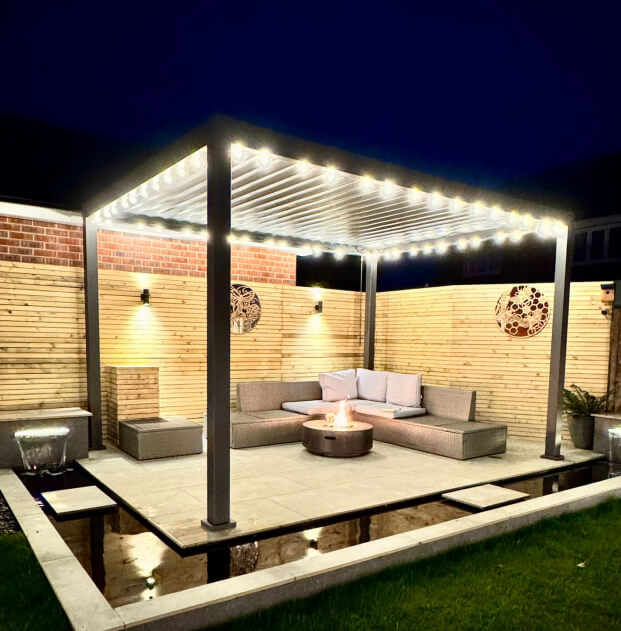
Most pergolas in Cheltenham are at their best after dark. Festoon lights, downlights in the beams and a socket for a heater all make it usable for more of the year. So plan the cables before the base goes down. Our garden lighting page has more ideas.
For climbers, wisteria, roses, clematis and star jasmine all do well in a sheltered Cheltenham garden. However, wisteria grows heavy with age, so the frame must be built to carry it.
Frequently asked questions
How tall can a pergola be without planning permission?
Up to 2.5 metres if any part is within 2 metres of a boundary. Further away, it can be 3 metres, or 4 metres with a dual-pitched roof. Listed buildings and protected areas have tighter rules.
Do pergolas in Cheltenham need building regulations approval?
A simple open pergola normally does not. However, a large structure with a solid roof, or any electrical work, can bring building regulations into play. All outdoor electrics should be installed and certified by a qualified electrician.
Can I attach a pergola to my house?
Yes. A lean-to pergola fixed to the house wall is common. If the house is listed, you will need consent first. The fixings must also suit the wall, especially on older brick and rendered stone.
What is the best material for a pergola?
For pergolas in Cheltenham, it depends on the house and how you will use it. Oak suits period homes and lasts for decades. Aluminium with louvres suits modern gardens and keeps the rain off. Treated softwood is the most affordable and ideal for climbers.
Thinking about a pergola?
We design and build pergolas in Cheltenham, Gloucester and across Gloucestershire, from simple timber frames to oak dining rooms. Take a look at our pergolas page, or contact our team to arrange a visit.